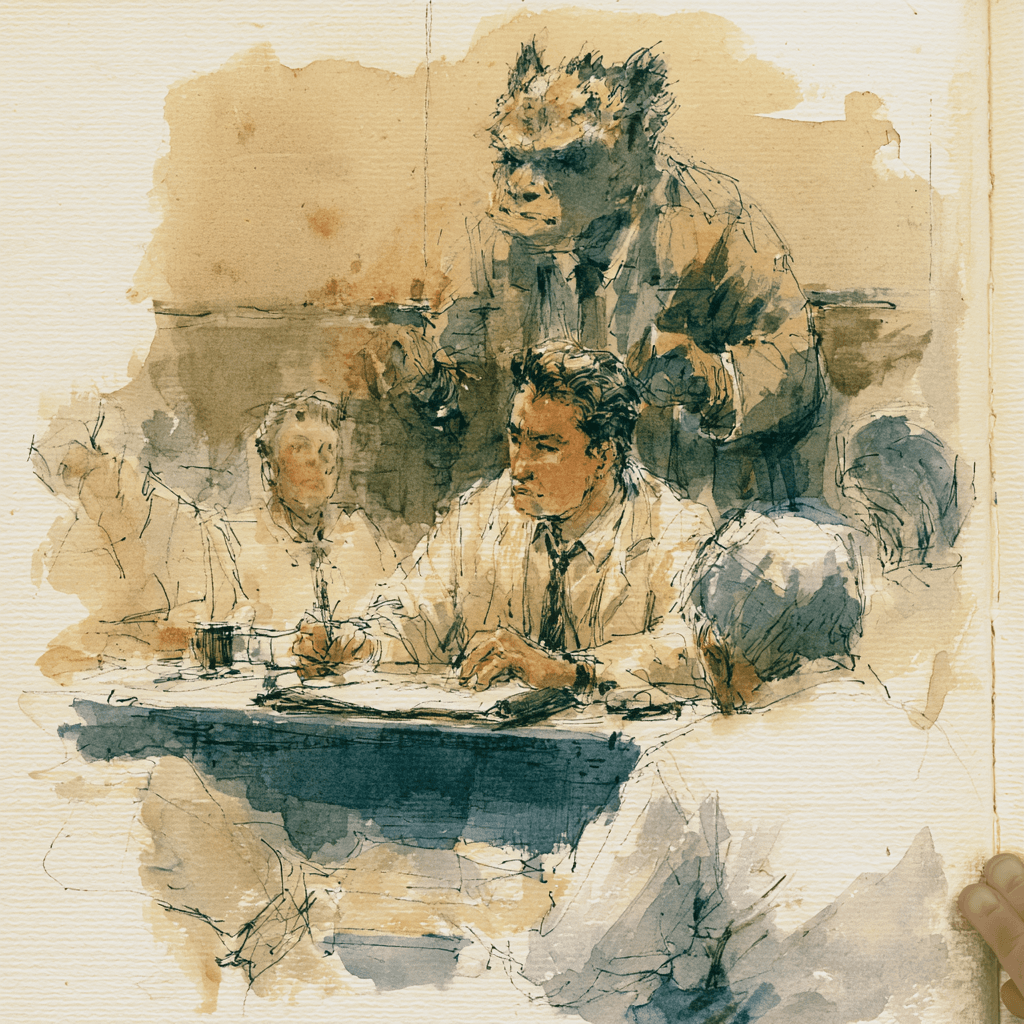
There's a move that looks like leadership and isn't.
You have a big ambition — a rewrite, a platform, a new product line. You give it a date. You say it out loud, to the team or to the whole market: this will be done by then. It feels decisive. It feels like the kind of thing a serious company does. People nod. The date goes on a slide.
And then everyone starts working backwards from a number that was chosen before anyone knew what the work actually required.
That's the whole problem, and it's worth saying plainly: a deadline set on a big idea is a guess. Putting it in a public announcement doesn't make it less of a guess — it just dresses the guess in a suit and dares anyone to question it. The scramble that follows isn't a sign the team is weak or undisciplined. It's the structural consequence of fixing time against something nobody has scoped.
What the Big Dated Commitment Actually Does
The unspoken assumption behind "done by then" is that you already understand the work well enough to predict it. For anything genuinely large, you don't. Nobody does. Large work is large precisely because of what you haven't discovered yet — the integration that turns out to be load-bearing, the assumption that doesn't survive contact with real data, the second problem hiding behind the first.
When you fix a date against that much unknown, you've created a clock running against a fog. As the date approaches and the fog hasn't cleared, the only variables left to move are the ones that hurt: quality drops, scope gets quietly butchered, people work weekends, or the date slips and the public commitment becomes a small humiliation. None of these are failures of effort. They're what has to happen when the time was promised before the work was understood.
And notice who actually pays. The person who set the date and said it out loud is rarely the one working the weekend to defend it. A public deadline on an unscoped idea quietly takes the team hostage to a number they had no part in choosing — they carry the consequences of a guess that wasn't theirs to make.
This is precipitation, not speed. Speed is a team that moves fast because it can be wrong cheaply. Precipitation is motion generated by a clock — everyone scrambling because a number is approaching, whether or not the scrambling produces anything that lasts. The big dated commitment manufactures precipitation by design, and then mistakes it for urgency.
The Discipline That Runs the Other Way
There's a way of relating ambition to time that produces the opposite of scramble. It isn't a method you buy or a ceremony you adopt — those come and go, and most of them get cargo-culted anyway. It's an underlying discipline, and it has four moves.
Find the problem. Not the dream — the problem. Start from something real and current that your customer actually struggles with, stated small enough to see its edges. "Rewrite the platform" is a dream. "Imports time out under load and take pods down" is a problem. Dreams have no natural size; problems do.
Size the appetite. Decide how much time the problem is worth — not how long it will take, which you can't know, but how much you're willing to spend finding out. This is the inversion that changes everything. The time becomes a budget you set, not a prediction you hope holds. A budget can't be missed. It can only be spent well or badly, and at the end of it you decide what to do next.
Include the team early. The people who'll build it should be in the room while the slice is being shaped, not handed a finished specification to execute. They're the ones who can tell you what fits the budget and what doesn't, where the real risk sits, which version of the idea is buildable in the time you've set. Shaping work without them is how you end up with an appetite that was never realistic in the first place.
Iterate and review. Ship something inside the budget. Then watch what it actually did — in production, with real users, against real numbers. And then make a decision: keep it, improve it, or clean it up and walk away. That decision at the end is not an afterthought. It is the entire point. It's the moment the work produces learning rather than just output.
Fixed Time, Variable Scope
Strip it down and it's one reversal. The scramble pattern fixes the scope — the whole big idea — and lets time be the casualty. The disciplined pattern fixes the time and lets the scope flex to fit.
Once time is fixed, the date stops being a threat. You cannot be late on a budget; you can only choose what to fit inside it. Every week the question is no longer "are we going to make it" — a question with a fixed, frightening answer approaching — but "what's the most valuable thing we can still do with the time we have left." That question has an answer the team can act on, every single week, calmly.
And the scope flexing isn't a compromise. It's the mechanism by which you stay pointed at value. When time is scarce and protected, you're forced to keep cutting toward the thing that actually matters, because you can't afford the things that don't. Variable scope isn't doing less. It's continuously choosing the most valuable remaining slice.
Why the Ending Matters Most
The part almost everyone skips is the last one: ship, monitor, decide.
A team running the scramble pattern ships the big thing on the date — or near it — and moves on. There's no monitor-and-decide step, because the whole effort was organised around arriving, not around learning. So the company never finds out whether the thing it spent six months on was worth building. It just starts scrambling toward the next big dated idea, carrying none of the knowledge it should have earned.
The disciplined loop ends in a decision precisely because it was never about arriving. You shipped a bounded slice in order to learn something, and now you know it: this worked, do more of it; this didn't, stop; this half-worked, here's the improvement worth making. Each cycle leaves you smarter about where to spend the next budget. Over a year, the difference compounds into two completely different companies — one that has learned its market in tight loops, and one that has guessed at it loudly, repeatedly, and expensively.
The Calm Underneath
I've written before that calm is manufactured, not innate — that teams don't stay calm under pressure, they prepare not to need to. This is the same idea pointed at planning.
The scramble around a big dated commitment is a panic state with a calendar invite. It feels like ambition and lands like anxiety, because everything is staked on a guess and the guess is coming due. The disciplined loop produces calm for the simplest of reasons: nothing is ever staked on a guess. The unknown is bounded in advance. You've decided how much you'll spend finding out, the team helped shape what fits, and whatever happens you'll learn something real and get to choose what's next.
Prepare what can be planned, so you can meet what can't. At the scale of a single piece of work, this is what that looks like. Find the problem. Size the appetite. Bring the team in early. Ship, watch, and decide.
A deadline on a dream is a guess in a suit. An appetite on a problem is a discipline. They use the same calendar and produce opposite companies.
Thomas Riboulet is a Fractional VP of Engineering working with European tech companies. He writes about engineering leadership, team structure, and sustainable delivery at insights.wa-systems.eu.