Dimitri has been at the company for two years. He's good at his job, cares about the product, and — until recently — felt like he understood where the company was going.
Then came the quarterly all-hands.
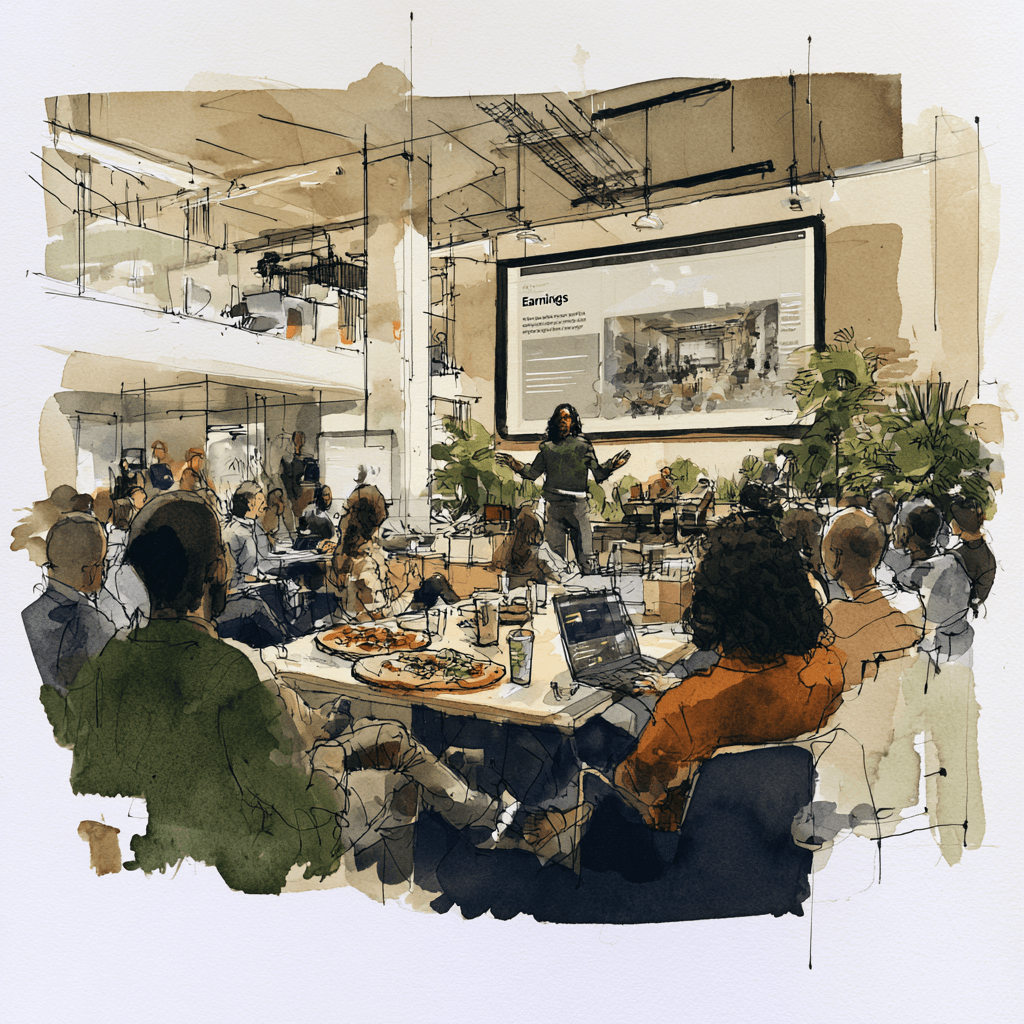
Ninety minutes. Forty-three slides. Revenue numbers he could have found in the last board update email. A roadmap he'd seen in three previous meetings. A founder who spoke for fifty minutes, then opened the floor to questions. Someone in the front row asked something safe about hiring plans. Someone else asked about the office policy. The real questions — the ones about the strategic pivot that had been rumored for weeks, about the two engineers who'd left quietly last month, about whether the Series B was actually on track — stayed unasked. Dimitri typed them into a notes app and deleted them on the way back to his desk.
He left knowing less than when he arrived. Not about the numbers — those he'd absorbed. About whether leadership had a clear picture of where the company was going, and whether they trusted the people in that room enough to share it honestly.
That's the signal most all-hands meetings send, and most leadership teams don't realize they're sending it.
The all-hands meeting didn't start as theater. It started as something genuinely useful.
Two founders, three early hires, a patio, Friday evening. Someone brings pizza. Someone opens a beer. One of the founders says: here's what happened this week, here's what's keeping me up at night, here's what I think is working. Everyone responds. Everyone leaves knowing what's actually going on. The loop is small enough to hold everyone in it, and the format is honest because the setting demands it — you can't deliver a fifty-slide deck to four people on a patio without it feeling absurd.
This is where the all-hands comes from. Its original function was to share context, build a common picture of reality, and maintain the sense that everyone — regardless of role — was part of the same story. It was culture-building in its most organic form, and it worked because the conditions were right: small group, high trust, no performance required.
Then the company grew.
At thirty people, the patio became a conference room. At a hundred, the conference room became an auditorium. The five-person conversation became a presentation. Slides appeared — first to help organize the information, then because slides were what you did. The Q&A stayed because Q&A had always been part of it. But the conditions that made the original version work had quietly dissolved, and nobody stopped to renegotiate what the meeting was actually supposed to do.
This is also why retrofitting the format is genuinely hard. Culture grows from small seeds. At five people it's almost automatic — you share context because you can't not, you're all in the same room every day. At thirty to two hundred, the habits that made the small version work need to be deliberately reconstructed, in a larger and more complex environment, often by leaders who never experienced the small version themselves. You're not just fixing a meeting. You're trying to plant a seed in soil that's already set.
Most companies don't attempt it. They inherit the format — quarterly, slide deck, Q&A — and run it on autopilot, gradually drained of the original intention.
There is a category error at the heart of how most companies run all-hands meetings. The meeting gets designed as a reporting session — here is what happened, here are the numbers, here is the roadmap. Leadership prepares slides. Leadership presents slides. Employees receive slides.
The implicit message: you are audience. We are stage.
This is the wrong frame entirely. The all-hands — whether company-wide or team-level — is not a reporting mechanism. It is a meaning-making mechanism. The question it needs to answer isn't what happened but why it matters and where we're going. Those are different questions, and they require a different kind of preparation.
A company all-hands done well is the moment where leadership tells the story of the organization — not the metrics, the story. Where we started, what we're learning, what we're building toward, and what the honest challenges are right now. The numbers appear, but they appear inside a narrative that gives them weight. Employees leave not with a spreadsheet in their heads but with a renewed understanding of why their work connects to something real.
An engineering town hall done well is narrower but just as purposeful. A single line anchoring it to company direction — the why — and then a genuine account of where the team is technically: what the main efforts are producing, what's been hard and why, what's becoming possible that wasn't before. The engineer in the room should leave thinking: I understand the terrain we're operating in, and I can see how my work fits into it.
Both formats fail the same way. They collapse into status reporting, the format signals distrust, and the Q&A becomes theater.
The Q&A problem deserves its own moment because it's the most visible symptom of a broken all-hands.
When the real questions don't get asked, it's not because employees lack curiosity or courage. It's because they've learned, through accumulated experience, that the Q&A is not a genuine exchange — it's a performance. Leadership performs openness. Employees perform engagement. Everyone goes back to their desks.
The learning happens fast. One all-hands where a direct question gets deflected with corporate language, one moment where a questioner visibly makes the room uncomfortable and gets a non-answer, and the unwritten rule is set: ask safe questions or ask nothing. Dimitri didn't delete his questions because he's conflict-averse. He deleted them because he'd run the calculation and knew the return wasn't worth the exposure.
The inverse is also true: one all-hands where a leader says that's a fair challenge and I don't have a clean answer yet — and means it — changes the room. It signals that the format is real. That takes courage from leadership, and it's rarer than it should be.
Marc, who runs engineering town halls for his team of eight, made a change six months ago that he didn't fully predict the effect of.
He stopped opening with the metrics slide. He started opening with a question: "What's one thing that happened this quarter that you think the team should talk about?" He gave it thirty seconds of silence and waited.
The first time, it was awkward. Bob eventually said something about a deployment that had gone sideways and what it had revealed about the monitoring setup. It turned into a twenty-minute conversation that was more useful than anything Marc had planned. The team left with a shared diagnosis and a concrete follow-up. Nobody consulted a slide.
Marc still shares the numbers. He still covers what the main efforts have delivered and what's coming. But the meeting starts from the team, not from him, and the shape of the conversation that follows is different — it has actual exchange in it, not just transmission.
He'd been running town halls for two years before that. He'd thought they were fine because nobody complained. He hadn't noticed that nobody said anything real in them either.
The all-hands is one of the few moments in an organization's rhythm where everyone is in the same room, pointed in the same direction, with the explicit permission to talk about the big picture. Most companies use that moment to present slides.
What it could be instead is the meeting where the company — or the team — briefly becomes coherent. Where people leave with a shared sense of the terrain, a story that connects their work to something larger, and the evidence that leadership is telling them what's actually true.
Dimitri would have stayed for that meeting. He would have asked his questions. He wouldn't have deleted them on the way out.
The format is the same. The intention is different. That difference is entirely within the control of whoever runs the meeting.
Thomas Riboulet is a Fractional VP of Engineering working with European tech companies. He writes about engineering leadership, team structure, and sustainable delivery at insights.wa-systems.eu.