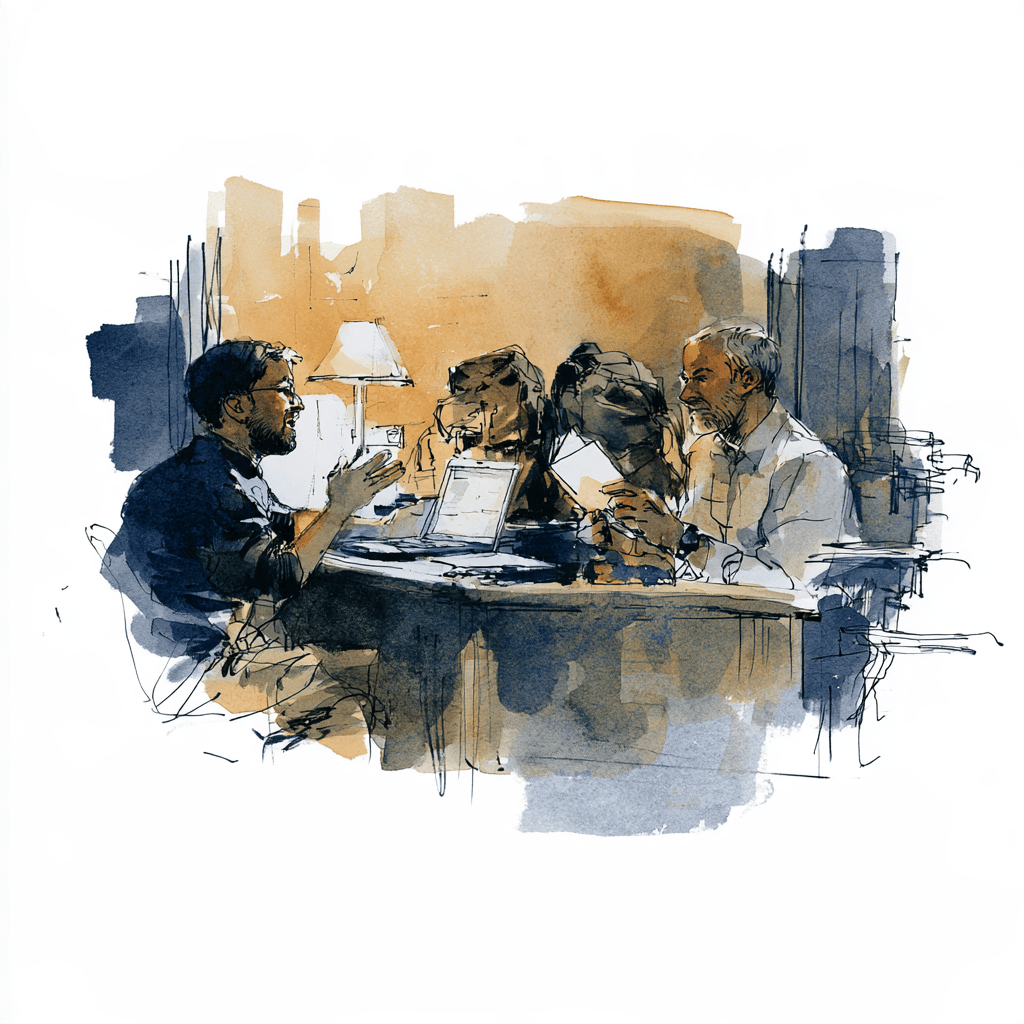
In 2007 I was on a working holiday visa in Perth, Western Australia: a software engineer on a professional hiatus, paying my way as night manager at a hostel. I had a little Ruby on Rails, a lot of enthusiasm, and an idea. I pitched the manager, Steve, a proper room and guest management tool. Web-based, modern, the whole thing.
He held up a notebook.
"I can walk out of this building on fire with this under my arm and know what I need to know. Software needs electricity and internet. This doesn't. That's the difference between life and death for someone in my hostel."
That was the end of the pitch.
I was the one with the solution
For years I told this story as a story about Steve's good sense. It is. But the more useful half of it is the other side of the counter.
I was the builder. I had a tool I could make, so I went looking for a place to put it. Nobody had asked me for it. I hadn't asked Steve what kept him up at night; I'd assumed I knew, because I knew what I could build. Steve was the customer, and he was the only one in that conversation thinking about his actual problem.
That's the uncomfortable part. Inside most software companies, we are the twenty-something me at that counter: founders, product people, engineers, all excited about what we can build. AI has made that version of us louder, because building is cheaper than ever. And Steve, the customer, usually isn't in the room when we decide.
What the notebook proves, and what it doesn't
It's worth being precise, because the lesson isn't "notebooks beat software." Steve's hostel had five rooms and twenty-five or thirty beds: one line per bed, per page. The notebook was sized exactly to his problem. At a fifty-room property with two hundred guests a night, the same notebook becomes the liability, and software is the right answer.
So the test was never paper versus code. It was whether the solution fitted the actual shape of the customer's problem, as he lived it, not as the builder imagined it.
The test
I still run ideas through what I think of as the Steve test. It has two halves.
First, ask it yourself: does this need to exist, for the person it's supposedly for? Before anyone spends a minute on the metric, the hypothesis or the build. Most ideas survive it. The test isn't there to kill good work; it catches the ones that started from what we could build rather than from what someone needed.
Then take it to them. Asking on the customer's behalf is a start, but it's still us guessing at the counter. Steve could answer because it was his hostel; your customers can answer too, if someone asks them. Before building a feature or a product, describe it to a handful of the people it's for, and ask whether it would change anything for them. Not a survey, not a dashboard after launch: a few ten-minute conversations, before the first line of code.
The first half keeps the obviously unnecessary off the backlog. The second half is the only one that tells you whether you were right.
What happens to the person who asks
Picture the moment in a leadership or planning meeting when someone finally says it: does this need to exist? Have we asked anyone who'd use it? Watch what happens next.
Ignored. Nobody engages, and the meeting moves on. By next quarter, the person who asked has learned it isn't worth the breath.
Punished. The question gets read as obstruction, as "not seeing the vision." The asker is left off the next planning session. They stop asking, and so does everyone who was watching.
Rewarded. The question changes the decision, or at least forces someone to answer it out loud. Next quarter, someone else asks it too.
That's Ron Westrum's typology of cultures, pathological, bureaucratic and generative, seen through one small question. Most leadership teams believe they run the third. Watched closely, most run the first. Nobody intends it; culture decays by omission, one shrugged-off question at a time. What keeps it healthy isn't intention. It's attention.
Put Steve back in the room
- Make the customer conversation a step, not a favour. Nothing gets built until someone has talked to a few of the people it's for, and can say what they heard. It's the cheapest way to bring Steve into the meeting, and the most often skipped.
- Notice the question out loud. When someone asks a version of the Steve question, say that they just did. It's the fastest way to reward it without making it a ceremony.
- Let the "no" happen close to the work. The team shaping a feature should feel they can kill it themselves, on the spot, without escalating. If a bad idea had to go "up and around" to be questioned, that's your finding.
- Trace one back. Take the last thing that shipped and quietly underperformed. Somewhere near the start, there was a moment where the Steve question could have been asked and wasn't. Look for the pattern, not the person.
Steve kept his notebook. I kept the lesson, though it took me a while to see which side of the counter it was about.
Thomas Riboulet is a Fractional VP of Engineering working with European tech companies. He writes about engineering leadership, team structure, and sustainable delivery at insights.wa-systems.eu.